case file learning design
Asking why before building the training
How to tell a training need from a behavior, change management, or hiring problem.
By Diane Nguyen · First shared November 24, 2026 · 10-minute read
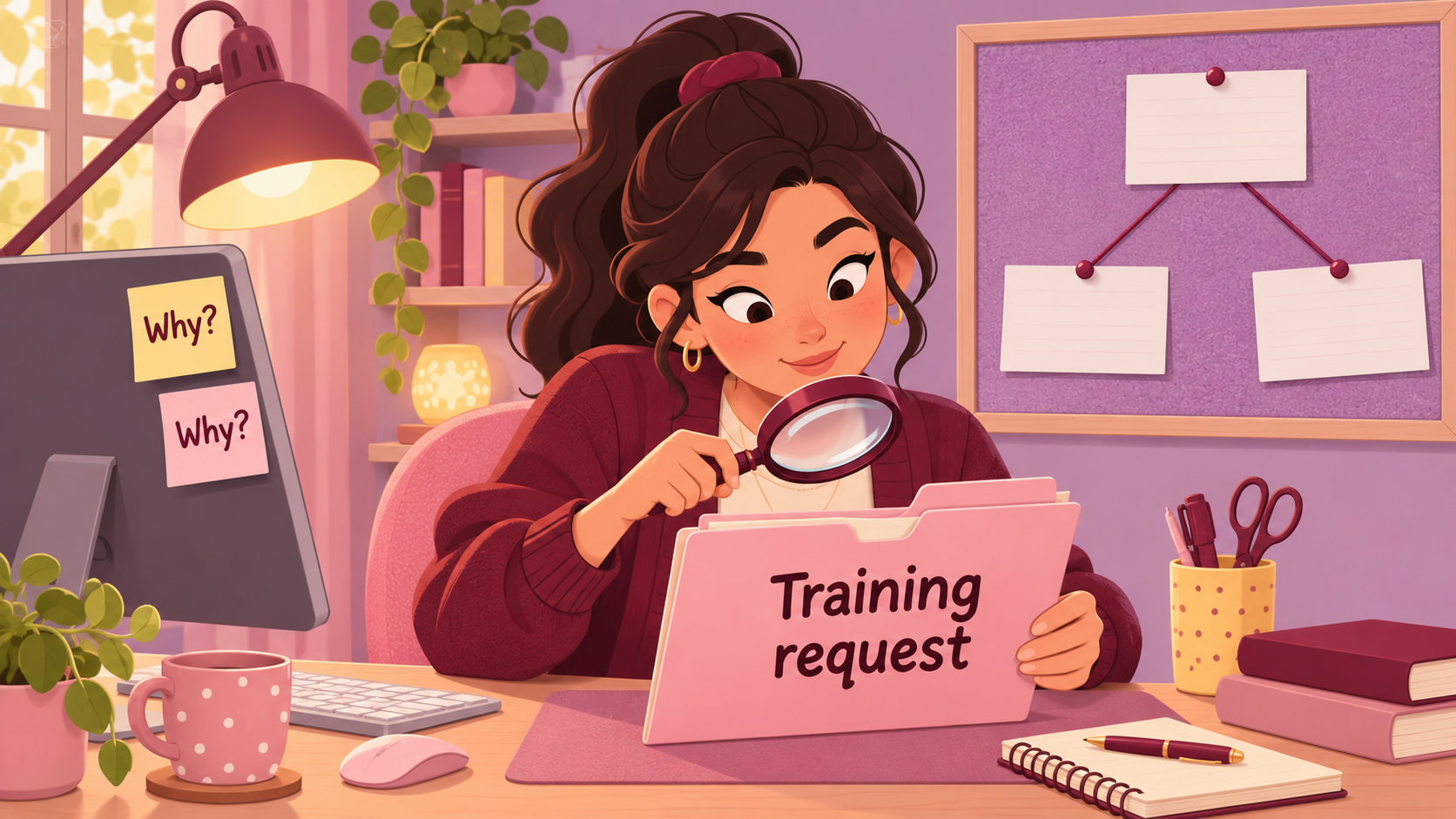
Every request has a why
As a learning designer, I get an influx of requests to create new training for our part-time staff, who coach the fellows (the students) in our program. Every 6 months, I take on a big project of about 12 branching trainings, plus side trainings and operational resources as they come up. That excites me, because I’m passionate about learning. But I also want to make sure I understand the why behind what I’m building.
Here’s how I figure out whether a request is really a training need, through 4 real cases and the questions I ask along the way. Every case ends with 1 of 4 verdicts:
- VerdictBehaviorThey know how, but they don’t do it.Habits and follow-through. Accountability and support help.
- VerdictChange managementThey can do it, but they don’t want to change.Understanding the why, plus buy-in from leadership, helps.
- VerdictHiring processThe role needs skills training can’t build fast enough.Job descriptions, knowledge checks, and who we hire help.
- VerdictTrainingThey don’t know how yet.A skill gap. Practice and feedback help.
The request that taught me
When part-time staff miss deliverables, it’s understandable that people get frustrated. I once got feedback that the training needed to teach part-time staff to turn in their grading deliverables on time.
Evidence
- Attempt 1Maybe they don’t know when it’s due.I embedded the deadlines in the training.Still late
- Attempt 2Maybe they don’t know the process.I trained them on how to grade.Still late
- Attempt 3What am I missing?I asked the part-time staff directly.“We understood the training.”
That’s where I got stuck. If they understood the training and knew what to do, maybe it wasn’t a training issue at all.
Verdict: behavior
What I did instead
I flagged it with our program managers and recommended regular check-ins and accountability. That conversation led to something bigger: I proposed a performance tracker for our part-time staff, and it was approved. Turning in grading on time is now one of the key indicators of whether someone is meeting expectations or performing at a high level.
On-time grading went up. The tracker helps program managers quickly spot who is falling behind and step in right away, and it prompts them to have coaching conversations with the part-time staff on their caseload.
Since then, I always ask the learners I’m building for what they need.
It happened again
The request was about HQ staff not pulling data from our LMS. I assumed it was a process issue, so I built a job aid, a guide, and a formal training on how to pull the data. They still weren’t pulling it.
So I made it even easier. Our LMS charged extra for its own dashboard, so I wrote a script in Google Apps Script that uses the LMS’s API to send weekly data updates as an Excel file, straight to the people who need it. I’m not a developer, so it took research, help from articles and resources, and plenty of testing. It also saves me about an hour a week.
But once the data arrived, they looked at it once and set it aside. That’s how I knew it wasn’t a training issue.
Statement
“We just don’t like doing it.” And when I asked why: “We just don’t like a new process.”
Many teams already had their own processes. People who had been with our organization a long time had historical knowledge of how things used to work, and each region had its own preferences and traditions. But we need one national process: keeping the data in one place is what lets us see trends across the whole organization.
This is where The Management Center’s guide “That’s how we’ve always done it” helps. PTR stands for preferences, traditions, and requirements. It helps you separate what’s actually required for good results from what’s simply familiar or preferred, which reduces bias. A single national process is a requirement. How each region used to do it is a preference or a tradition.
Verdict: change management
What I did instead
I ran into a challenge of cross-functional collaboration that people don’t talk about enough: I’m not their manager. So I worked to get buy-in from their leadership on why the data matters, so the change could come from their side.
Their leader championed the idea, brought me into their meetings, and made sure I heard their input and answered their questions. We’re still working on it. Change takes time, and we’re moving toward it step by step.
What I learned: making something easier isn’t always enough. People need to understand the why, and there has to be a shared agreement that a change needs to happen.
Training isn’t the answer to everything
Rule #1
Always question whether training can actually fix the problem, or whether it calls for a structural change or a process change.
That was one of the first things we learned in my master’s program at the University of San Diego, and it’s stuck with me.
I wrote more about sorting problems into training, behavior, and structure in Keep the data in focus.
When the fix starts with hiring
Our program teaches technical skills like Tableau, Excel, and SQL. I was asked to build training to teach those skills to our part-time staff so they could facilitate the sessions.
All of our part-time staff are alumni of the program, so they’ve been through the curriculum. But many of them don’t work in the field, haven’t applied the skills since, or have simply forgotten them. The baseline our fellowship provides is enough to learn the skills, but not enough to teach them.
Teaching a subject is very different from learning it. Our part-time staff are hired to teach, so some of that knowledge has to come with them from the start.
Verdict: hiring process
What I recommended
- Add prerequisites to the job description, so applicants know the subject knowledge we expect.
- Add a knowledge check to the hiring process, so we hire people who are ready to teach these skills.
- Look for the right profiles. I did data deep dives on which part-time staff, and which full-time roles, fit this work best, so we can find similar profiles going forward.
I partnered with our talent team to update the job description for the next cycle, and we’re still refining it.
We’re stricter with hiring now, and we’re getting higher-quality facilitation from people who have industry knowledge and can tell the stories behind the skills.
That’s the biggest lesson from this case: teaching technical skills is really about storytelling, drawing on your own experience to explain things in a way that makes sense. Without that experience, it’s hard to connect the dots. And if a fellow asks a follow-up question you can’t answer, that’s a disservice to them.
When training is the right answer
This doesn’t mean I’m against training. Our part-time staff are expected to act as career coaches, helping fellows navigate their journey with resumes and interviews. But many of them haven’t been through much of a job search themselves, so they didn’t know how to kickstart those conversations.
The data showed it. They were confused about what to say next and how to say it, and some felt imposter syndrome. If they weren’t confident talking about resumes and interviews, they would look for a more experienced part-time staff member to step in.
At its core, it was a skill gap: how to start the conversation, validate a fellow’s feelings while admitting you’re still figuring things out too, make them feel seen, and give honest feedback, especially to a peer who feels like they’re at the same level.
Verdict: training
What I built
A role-play session built on peer learning. I paired returning part-time staff who had worked multiple cycles with newer ones, so they could practice together, give each other feedback, and see what a high-performing returning staff member does in those conversations.
Afterward, a lot of the newer part-time staff said they felt much more confident going in. In a Zoom poll after the session, most participants rated their confidence 4 or 5 out of 5. We were also honest with them: practice makes perfect, and the more initiative you take, the more you get out of it. Most of them agreed.
How I diagnose a request
These are the 2 tools I use most to get to a verdict before I build anything.
1. Ask why 5 times
The 5 Whys framework has always helped me get to the bottom of why we need certain training, or anything else, to be built. It’s saved me a lot of time.
Say someone asks for training so part-time staff can input their hours correctly. Here’s how the conversation goes.
Interactive · click Ask why to pin the next clue
The request“We need training for part-time staff on how to input their hours.”
- Clue 1Why do we need that training?They’re not putting in their hours correctly.
It’s a simple question, but it narrows things down, and it makes the requester think about the next steps, too. Sometimes it takes more than 5 whys to get to the real problem, and that’s okay. It’s a framework, not a rule.
2. Ask questions, and push back politely
Recently, a colleague asked me for more training on coaching. Coaching is one of our pillars, and we’ve already done a lot of training on it. As Case 04 shows, sometimes coaching training is the right call, so I check first. When I push back, I’m transparent:
“To be straightforward with you, I want to recognize whether this is a training need or a structural problem. We tend to think we can train our way out of a behavior problem, or out of something built into the system. If it’s structural, let’s understand the core problem, the why, before building any training, so we’re aligned and not wasting time.”
I’m someone who asks a lot of questions. If a colleague says we need more training on running office hours, I’ll circle back with these:
My questions
- How are office hours going right now?
- Is there time and structure for office hours?
- What feedback are we getting from fellows, and from our part-time staff?
- How is this being recorded?
- Does this tie into the bigger goal of our organization? For our workforce development program, that’s employment and career readiness.
Getting the full picture first tells me exactly what kind of training, if any, they need.
How-tos for tools, SOPs for processes
Sometimes the fix isn’t a new course at all, but a resource people can use in the moment. A lot of people request training on our LMS, and training is important for a baseline. But people don’t need to know every step until it actually comes up, and that’s when they realize they need it.
That’s where how-to guides come in. I use Scribe AI to build step-by-step how-tos, and it’s a tool I highly recommend. It takes the screenshots for me, it’s easy to update when something changes, and it’s powered by AI. Even though people learned it in training, they tend to forget, so they open these guides all the time.
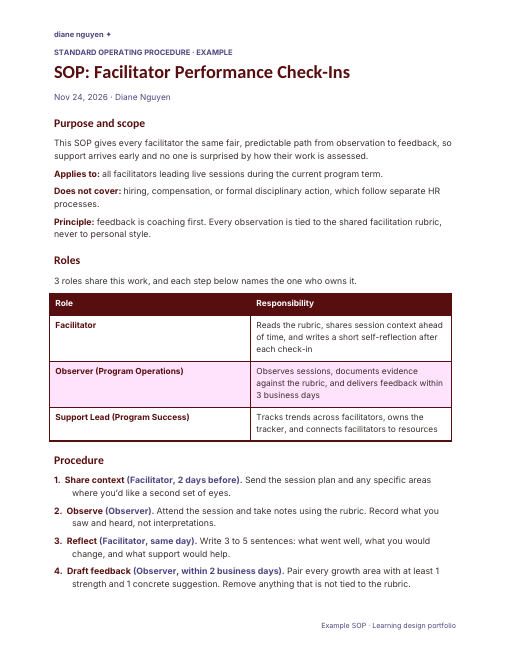
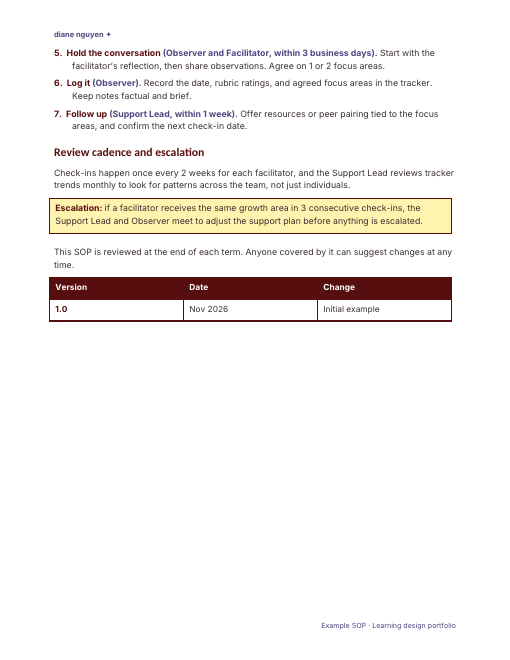
For processes, we can train people, but that’s where SOPs come in. An SOP, or standard operating procedure, shows 3 things: which team owns each step, the timeline for each step, and what the process looks like from start to finish. It gives everyone one place to track things down.
I usually write my SOPs in Google Docs, so they’re easy to share, comment on, and keep up to date. Here’s an example, shown in the format I use. It connects back to Case 01: facilitator check-ins were one of several reasons we built the performance tracker.
Interactive · click a tab to open that part of the SOP
SOP: Facilitator performance check-ins
Google Doc · Example · Nov 24, 2026This SOP gives every facilitator the same fair, predictable path from observation to feedback, so support arrives early and no one is surprised by how their work is assessed.
- Applies to
- All facilitators leading live sessions during the current program term.
- Does not cover
- Hiring, compensation, or formal disciplinary action, which follow separate HR processes.
- Principle
- Feedback is coaching first. Every observation is tied to the shared facilitation rubric, never to personal style.
Closing notes
The takeaway
Never take a request at face value. Always figure out whether training is really the solution.
As a learning designer, I love creating learning experiences, and I’ll find every avenue to build something. But I only want to create a product that will actually work and make an impact. If you’re wondering why a training isn’t working, it may be time to ask: was this meant to be a training, or a conversation about development?