case study real work
Keep the data in focus
Running qualitative focus groups to measure the impact of training and employee experience.
By Diane Nguyen · First shared November 21, 2026 · 9-minute read
Part 2 of 2: evaluation · part 1 is Sprinting to the start line
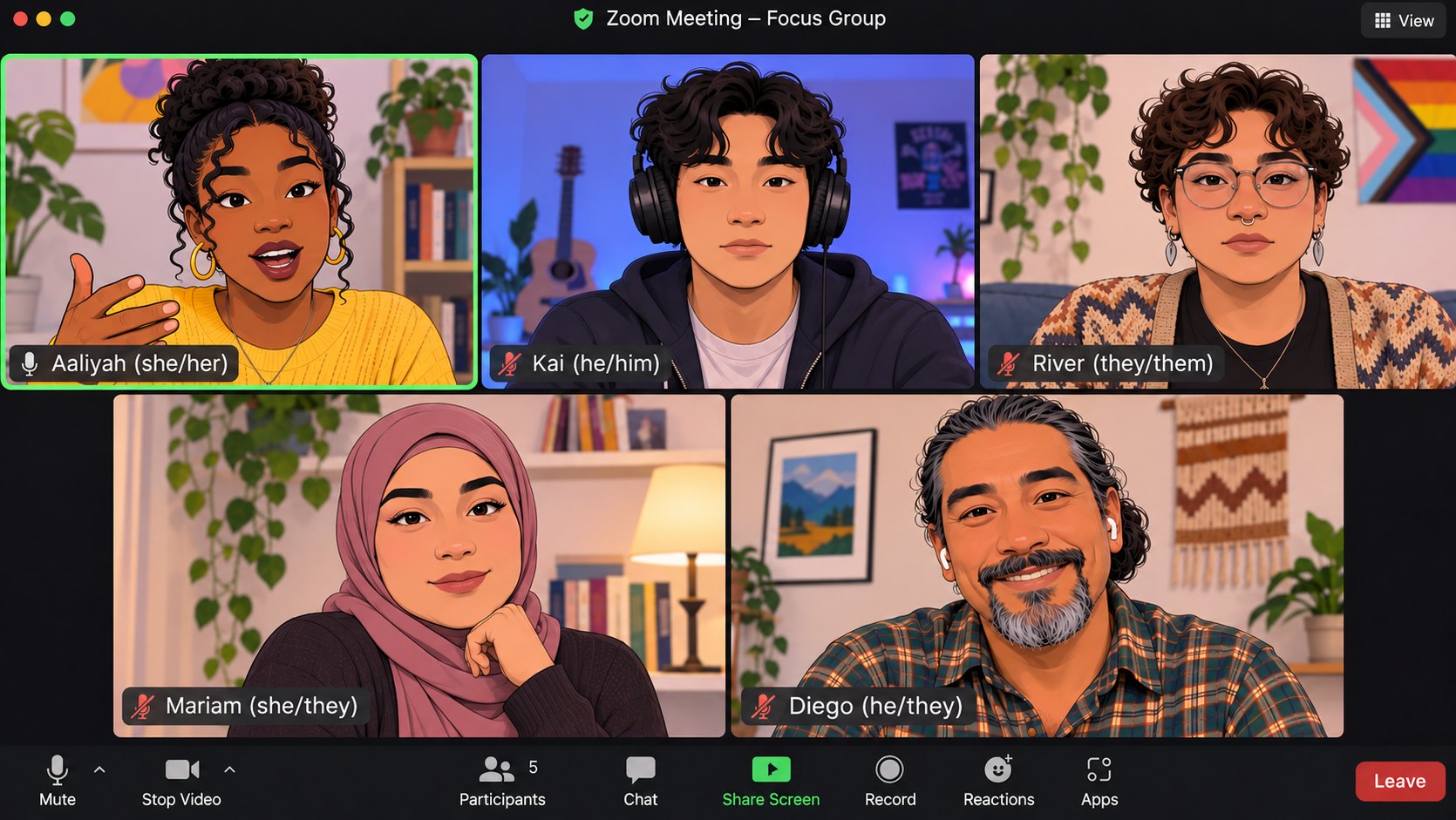
At a glance
Who: COOP Careers’ part-time staff, who coach and teach our fellows
What: 3 national focus groups, one per track, 1 hour each, 6 people or fewer per group, about 18 participants in total
My role: organized them, co-wrote the questions with my colleague, ran the ice warmer and wrap-up, took notes, and made sense of the feedback
Tools: Zoom (recordings and transcripts) and Claude (themes and summaries)
Result: changes to our fellowship curriculum, new support for facilitation, and a structural issue raised with leadership
Background
COOP Careers is a fellowship program that helps first-gen, low-income recent grads land their first good job after college. My role is a cross-function between operations and curriculum design for our part-time staff. A separate team designs the curriculum for our fellowship tracks: digital marketing, data analytics, and financial services. I used to be the point person for digital marketing there before I moved into this role.
Our part-time staff go through a 3-week training to prepare them for our 16-week program, as they become career coaches and instructors. During the program, they also get just-in-time trainings: short trainings on a topic tied to a session they’re in charge of facilitating. For example, a week before mock interviews, they take a mock interview just-in-time training, so they know the logistics. I wrote about how I designed the sprint in Sprinting to the start line.
I don’t collect feedback on how training went right after the 3-week sprint. I wait until the end of the program, when our part-time staff have completed their contracts with us.
How I know if training worked
Instead of relying on surveys, I proposed a part-time staff performance tracker. Because I’m part of operations, I was able to get it approved.
Interactive · click a topic to open it
Why focus groups?
Quantitative data can tell you so much, but stories add the value. The goal is to understand what our part-time staff need during the program, what training isn’t addressing, and how we can help.
Adults are busy. When they take a survey, they want to get it out of the way, and they might skip an optional box to share more because the survey already feels long. In a focus group, people have usually opted in, and most prefer to talk and share their stories out loud rather than type them up.
I still do a lot of one-on-ones, but I also run focus groups with my colleague in program design, who creates our fellowship curriculum. Our fellows’ journey and our part-time staff’s journey are intertwined, so running them together gives us a fuller understanding.
Who I invited
I keep each focus group to 6 people or fewer. With more, people tend to overlap, and we want to respect everyone’s time. I aim for a mix:
Interactive · click a card to flip it
This is the best thing about focus groups: the peer learning. I think the value of peer learning is greater than we think. When people hear what their peers say, it draws out new ideas and those “aha, I agree with you” or “I don’t agree with you” moments.
How we ran them
One focus group per track, so 3 national ones on Zoom, an hour each.
Interactive · click a topic to open it
The questions
Every question loops back to the training’s learning objectives. I keep them open-ended and focused on the why of everyone’s experiences.
| Instead of | I ask |
|---|---|
| “How was training?” | “How has training supported you with doing X, Y, and Z tasks?” |
| “On a scale of 1 to 10, how prepared did you feel?” | “Can you tell me about a time you ran an Excel session?” |
| “Did the training help you track fellows?” | “Can you tell me about a time you had to check the progression of your fellows and you were stuck?” |
Feedback isn’t only constructive. We also need to know when something was good, what makes it good, and how we can build on it.
Making people comfortable
I always start with an icebreaker, or ice warmer, that leads into the questions. Everyone shares their name, their pronouns, how long they’ve been working with us, and their role.
“Can you tell me about a time this cycle when you felt you really impacted a fellow’s experience?”
- Validate, don’t promise. “I hear how you feel. That can be very frustrating. Thank you so much for sharing.” But I never promise what we’re going to do.
- Keep it casual, so people know I’m not judging and they can say whatever they want.
- Invite cameras, with a joke. On Zoom, I encourage everyone to turn their cameras on. I open with a light joke about it: “If you’d like to have your cameras on, that would be amazing. It helps me read your body language and know if I’m doing a good job, since I don’t know how to read social cues.” It keeps the tone lighthearted.
- Stay open. Even if I disagree, I won’t say so. I’d say something like, “I never thought of that perspective before.”
Making sense of it all
After this round of 3 focus groups, I did 3 things:
- Built a profile for each participant: who they are, their role, how many cycles they’ve been with us, their manager, their track, and where they currently work. This was for internal use only, so we know who was in each group and who we’re designing for, and so I have data and ratios to filter through later. I built these during the sessions, not beforehand, because there’s usually a drop-off. For example, 10 people signed up for one group, and 6 showed up.
- Downloaded the transcripts from each focus group. Not the videos: realistically, people rarely watch them back.
- Built a focus group dashboard in Claude. I uploaded the transcripts and the profiles, and it pulled out 10 themes for me to look out for, tied back to the training, plus any themes beyond training that my program design colleague might want to check out. Then a summary tab for each track, plus all 3 together, so we can see what we can do for the organization as a whole.
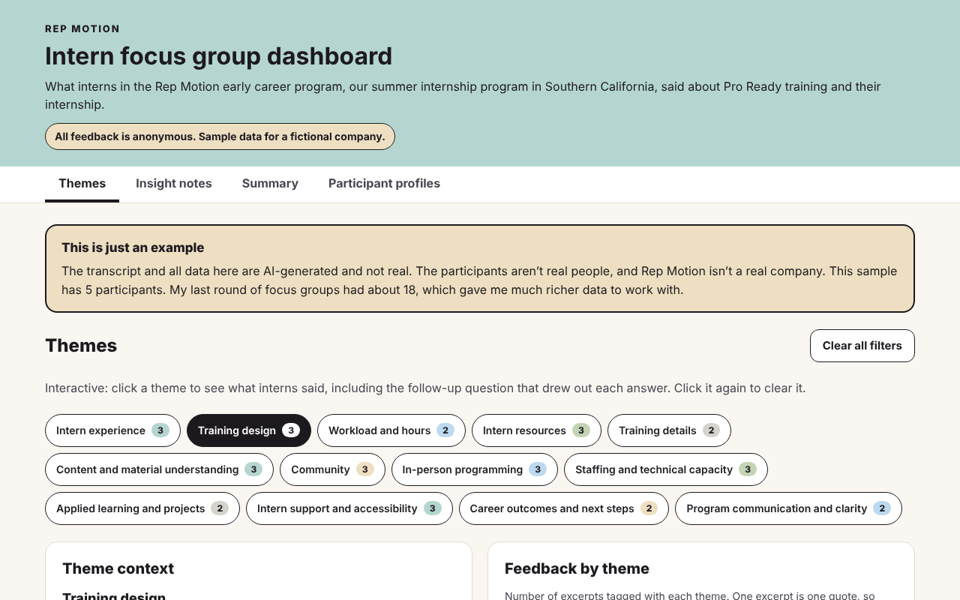 See the sample dashboardA recreation for Rep Motion, a made-up athleisure brand and its internship program. Explore themes, insight notes, a summary, and participant profiles.
About the example: to show you how my dashboard works without sharing anyone’s personal information, I recreated it for a fictional company. I used AI to write a sample focus group transcript, and I built the dashboard with Claude, the same way I built the one for COOP Careers. The sample is simpler: 1 group of 5 interns, with no tracks.
A note on privacy: our part-time staff knew they were being recorded and that their words would be written up in notes. We removed all participants’ names, so nothing points to who said what.
Not everything is a training problem
Organizations can think everything can be fixed with training. That’s not the case. We have to analyze what can be fixed with training, behavioral changes, or structural changes.
Interactive · click Next to go through all 3
1 of 3
Training
They were never trained on it, or the training didn’t stick.
For example, if part-time staff aren’t turning in their timesheets, is that because we didn’t train them? Is it behavioral, where they need coaching? Or is there some other reason? You can train someone on a process repeatedly, but if there’s no want or urgency, it might not be a training issue. Ultimately, we have to understand the why.
There’s also something our part-time staff don’t always see: even though we present the learning objectives to them, our leadership team has a certain set of expectations for what they should do. So if part-time staff feel the training didn’t align with their job description, that’s a bigger conversation I can bring back to leadership.
What changed
About 18 part-time staff took part in total. Here’s what their feedback changed.
Interactive · click a card to flip it
How I’ll know it worked
We’ll review the performance tracker again next cycle. We’ll also keep looking at our quantitative surveys, including satisfaction, but they aren’t the main measure. The next round of focus groups and one-on-ones will also help.
What I’d do differently
Your focus group checklist
Here’s your guide to kickstart your first focus group. It’s also a job aid you can use for your next session.
Interactive · click the card to open the checklist
Focus group checklist Before: 9 stepsDuring: 9 stepsAfter: 6 steps Open the checklistThe takeaway
Don’t take feedback personally. I know I can be scared of feedback, because when I build a training, it’s my baby. I put significant work into it, including many interviews and discussions. But sometimes, it might not work. That’s why it’s so important to collect feedback, so you can iterate and create new content instead of keeping things standard.
Think about what’s in your control and what isn’t. Collect both positive and growth feedback, because knowing why something works lets you do it again. And elevate multiple voices: you can’t rely on one or two people, because everyone has very different opinions.