case study real work
Playing as an adult
The benefit of in-person onboarding training to build community.
By Diane Nguyen · First shared November 23, 2026 · 7-minute read
Proposing an in-person session
In 2023, about 2 years after COVID, COOP Careers was putting a big emphasis on community and peer learning in our program. That starts with our part-time staff. They work in teams of 4, and each team supports a caseload of 20 fellows.
After their training, there was usually an informal celebration. I wanted to see if we could combine that celebration with some in-person training. People were coming back together for in-person experiences, and we knew the organization wanted to test in-person programming again in the next few years. Before COVID, all of our programming was in person, and like many organizations, we switched to virtual. This session was a small, intentional step back.
Since I was based in the Bay Area, I proposed one in-person session that combined community and learning. It also became the in-person session I mentioned in Sprinting to the start line.
At a glance
Who: about 32 part-time staff, in 8 teams of 4
Where: a rented classroom in San Francisco
How long: 3 hours: 1 hour of training, 1 hour of lunch, and 1 more hour of training
My role: proposed, designed, and organized it; 2 of our HQ program managers helped facilitate
Skills: learning design and development, facilitation, and event and room design
The objectives
I wrote the objectives using the ABCD method: audience, behavior, condition, and degree.
Interactive · click a card to flip it
Designing the training
Basic needs first
I started with Maslow’s hierarchy of needs. Before any learning happened, we made sure everyone had checked in, had snacks, and was settled and ready to go.
Why in person
Many of these part-time staff had never met each other, or had only met virtually. And even though each person works on a team of 4, they also collaborate across teams: each program manager oversees about 16 part-time staff, and 2 program managers were there that day.
The flow
Adults need to know the why, but research shows play matters to adults, too. So I designed the session to get people moving and talking, not just listening.
Training first, then lunch, then training. The opening activity helped people get comfortable. Lunch was informal on purpose, so people could get to know each other without any work assigned. Then we went into the more structured work. As many learning designers know, time is one of our biggest limitations, so we had to work creatively with the time we had.
Setting up the room
I’m big on using space intentionally, so I planned the room as carefully as the activities.
Not to scale. Each circle is one part-time staff member; each dashed box is a team of 4.
- Assigned seats by team. Each team of 4 sat together, so they could work as a team from the first activity.
- One long table per program manager. With 2 program managers, there were 2 long tables. Teams sat at their program manager’s table, so they could collaborate with the other teams they’d work with all cycle.
- A screen up front. A projector screen on a rolling stand let everyone see the slides when we needed them.
Room design could be a whole post on its own, so I wrote one: Using furniture to design for success.
The 3 hours, step by step
Interactive · click a stop on the timeline to see what happened
Hour 1 · 20 minutes
Four strings, one Sharpie
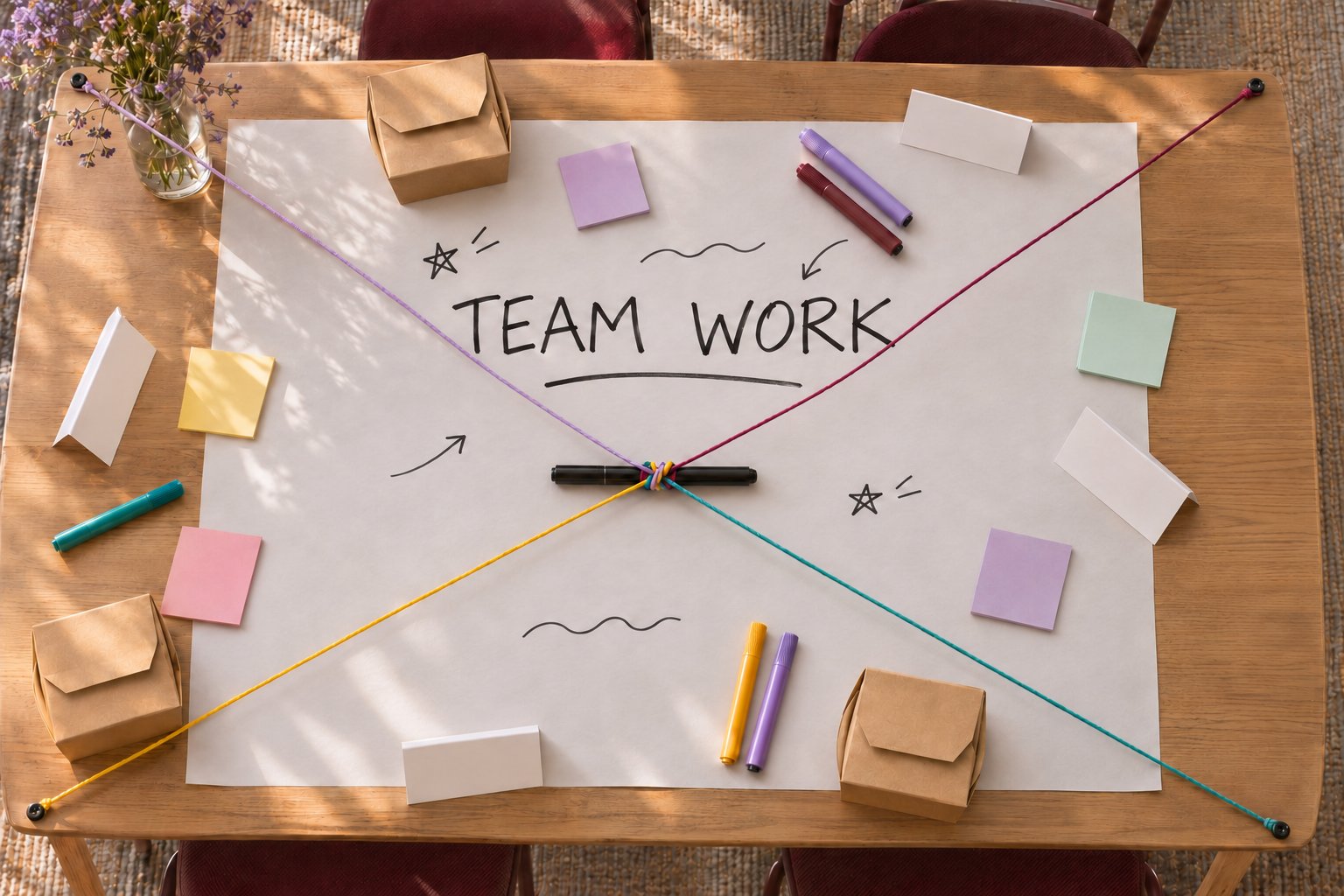
I wanted to promote engagement without forcing anyone to have fun, so I created an activity that got people moving. Adults need the why, but play helps, too.
Each team got a big sheet of poster paper and one Sharpie with 4 strings tied to it. Holding the strings together, the team had to write “COOP” in the middle, and each person’s name in a corner.
It worked as an introduction, but it was also communication practice: the only way to finish was to talk it through as a team. At the end, everyone voted on which team wrote it best. Teams that finished early decorated their posters to show their personalities.
What happened
What people said
After the session, we surveyed part-time staff, with questions tied back to the learning objectives. Here’s what they told us:
- They got to know each other and humanize their team, and they appreciated the time we gave them.
- They valued meeting part-time staff from other teams, people they wouldn’t usually see.
- They wanted more in-person opportunities like this.
- Our HQ staff appreciated it, too. They got to know their part-time staff in a way that’s hard virtually, where you can’t read body language.
What we heard to improve
- Location. We chose San Francisco because it’s our main location, but the Bay Area is spread out. People came from Modesto, Los Banos, and Marin. When you ask people to travel that far, you need their buy-in on why they’re there.
- Parking. People wished parking had been covered. We understood, but it wasn’t feasible for our organization.
What it changed
The session showed us that in-person time drives community and shapes the whole experience, because first impressions are everything. When part-time staff get along with each other, fellows benefit.
That proved true that cycle. We had a very high satisfaction rate with our fellows, and many survey responses said they felt supported by their part-time staff, and that the team communicated well and worked as a cohesive group.
By the numbers
80 vs. about 40
Our part-time staff Net Promoter Score (NPS) that cycle was 80, double the roughly 40 it usually sits at today. We haven’t held an in-person session for part-time staff since.
What I’d do differently
- Make “mandatory” clear, and follow through. We took attendance, but many people arrived late, some by an hour, even though it was a mandatory training. Several said they didn’t realize it was mandatory. Since the event felt informal, we didn’t treat lateness as a performance issue. Looking back, I’d emphasize that it’s mandatory up front, and give direct feedback when someone arrives an hour late.
- Connect it to the virtual training. Before this session, part-time staff had virtual training on the logistics: the part-time staff manual, platform onboarding, and more. I wish I’d tied those sessions into this one, as a reminder that helps them retain that knowledge.
The takeaway
A lot of the mindset has shifted to “we can do this virtually, so why would I drive in?” But look at your goals. Training that’s purely online can be hard, especially for an organization built on community and peer learning. Peer learning can happen online, but once you meet someone in person, the energy shifts. Having some kind of in-person touch point is always worth it.
There will always be people asking why they need to be there. They’re tired, they’re busy, it’s a lot of work. That’s true. In-person training is a heavy lift. So emphasize the why. I recently talked with someone at LinkedIn about how hard it is to get people to show up to in-office events and activities. Incentives matter more than ever. Being paid for the time isn’t always enough. I like using food. It’s a small thing, but it helps a lot. Other incentives help, too, along with showing people the impact their time will make.