gamification hot take
How GTA 6 taught me about building learning for high school seniors
How to apply game mechanics to teach students important life skills.
By Diane Nguyen · First shared November 23, 2026 · 7-minute read
A better boyfriend simulator?
As I write this on November 23, 2026, GTA 6 has just been released, and my social media feeds are full of content about it. I’m not playing it yet, but my partner is, and I’ve been watching over his shoulder. As a gamer, I already know a good deal about the gameplay from everything I’ve seen online.
What interests me most is the storyline. It reminds me of The Sims 4, one of my favorite simulation games of all time.
Right now, people online are saying GTA 6 is teaching men to be better boyfriends.
In chapter 1, Jason has to complete a few tasks before he picks up his girlfriend, Lucia, from prison. He paints the walls of their house, picks up flowers, and gets a car to pick her up. He does it all because he loves her, and each task improves their relationship level.
Plenty of men on social media have joked that they should be doing the same for their real girlfriends, because seeing Lucia happy made them happy. It’s humorous, but it also shows how much video games can teach us about real life. Newsweek has covered the trend as well.
GTA 6 made me realize that we can turn everyday tasks into a visible progress bar. As a learning designer, I think that’s a powerful mechanic to use, not just in game design, but in any learning experience.
Games are a powerful way to learn
In my experience, many people from older generations have told me, “I don’t understand why you play this game. You’re wasting your time.” But gaming is a powerful vehicle for both storytelling and learning.
More people are recognizing this, and research backs it up. A 2016 meta-analysis of K–16 students found that digital games significantly improved learning compared to non-game instruction, and that thoughtful game design plays a key role.
Beyond the adult learners I support at work, I volunteer with a nonprofit that supports college readiness, helping high school students build the life skills they need to transition successfully into college. Because I work with these learners regularly, I’ve been considering how we could teach these skills through methods other than lectures. Gamification is a great fit for that.
I played The Sims 4 extensively in high school and college, which leads me to ask: how could I recreate that experience for students and build that kind of learning environment?
What I would build: a freshman year simulator
This is a concept project. I’m not building it, but I want to share my thought process for how I would design it.
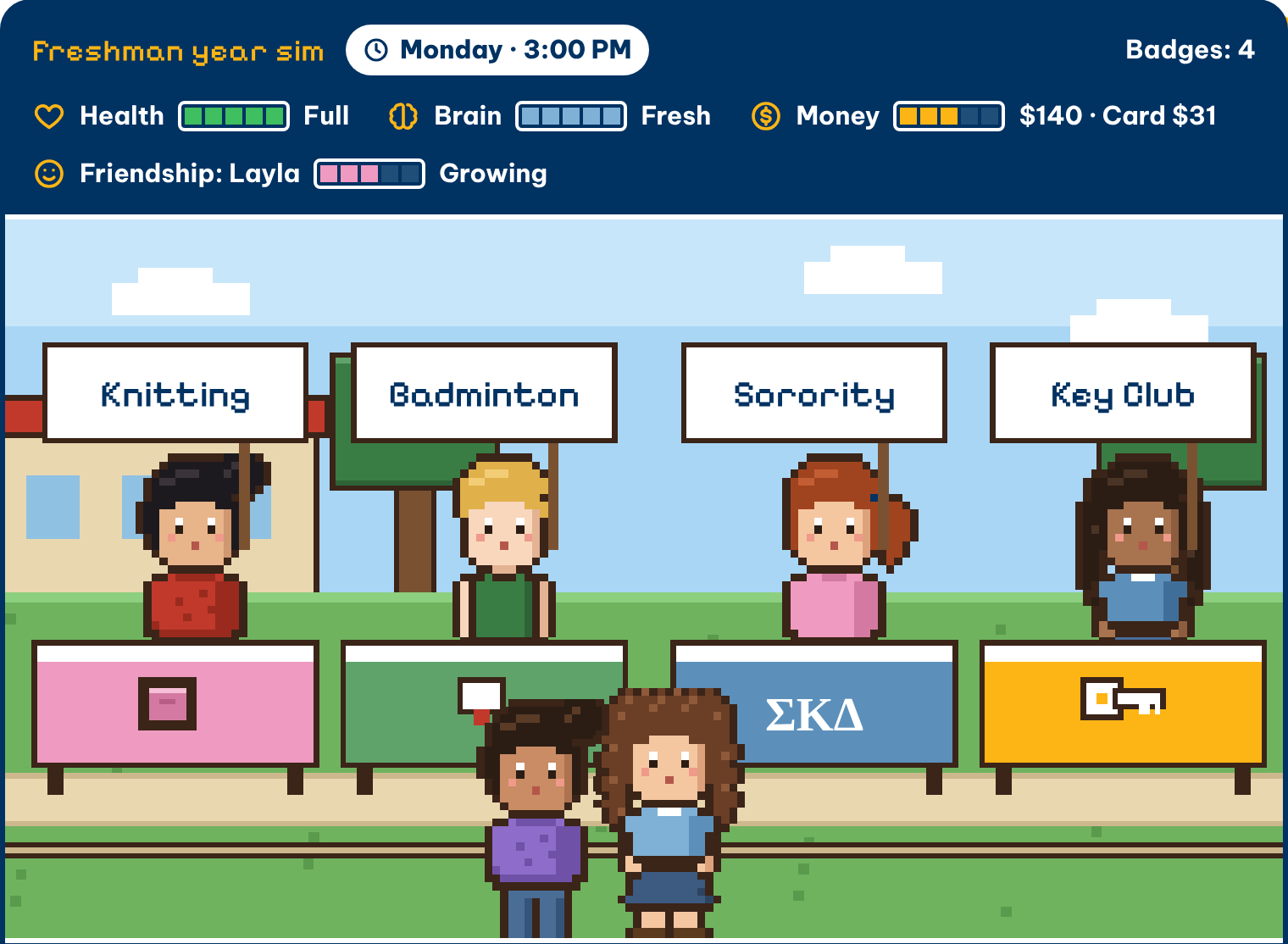
Picture a life simulation game. You’ve just graduated from high school and received your acceptance letter to a university. Now you need to figure out how to move, settle in, and make it through your first year. The visual style could be realistic, like GTA 6 or The Sims, or a pixel-art game, like Stardew Valley or Fields of Mistria. A cute, chibi-style look would help it feel more lighthearted.
Who it’s for
High school juniors and rising seniors, like the students I volunteer with.
Learning objectives
I wrote these using the ABCD method (audience, behavior, condition, and degree). Given a simulated first term of college, high school juniors and rising seniors will be able to:
- Take ownership of daily life. Complete daily tasks, like laundry, meals, and cleaning their room, without in-game reminders, and finish the term with 0 roommate strikes.
- Manage their time. Build a weekly schedule that fits classes, homework, and any work hours with no conflicts, and turn in at least 90% of their homework on time.
- Adapt to a new environment. Use at least 2 campus resources, such as their college counselor and the financial aid office, before classes start, and join at least 1 club or community.
- Set boundaries. Decline work hours that conflict with their class schedule, and stay enrolled in all of their classes through the end of the term.
How the objectives connect to the game
| Objective | Where students practice it | Badges earned |
|---|---|---|
| 1. Take ownership of daily life | Laundry day, Taking care of your nutrition, the messy dorm choice, and the gym side quest | Taking care of yourself, Getting food, Healthy habits (hidden) |
| 2. Manage their time | Sign up for classes, Balancing your homework, and Grades come in | Time management, Finishing homework on time, Good grades |
| 3. Adapt to a new environment | The letter, Financial aid, Move-in day, New student orientation, Join a club, Building and expanding your network, and the community service side quest | Big transitions, Managing your finances, Planning and independence, Making a friend, Joining a club, Socializing, Giving back (hidden) |
| 4. Set boundaries | The work-hours choice and the part-time job side quest | Working student (hidden) |
How the game works
Instead of levels, the game follows the flow of everyday life. Like Stardew Valley, the days keep going and your life keeps moving forward. You don’t track which level you’re on. After you settle in, the rest is everyday gameplay until the end of the term, and you earn badges for everyday accomplishments, like getting food, joining a club, socializing, finishing homework on time, and earning good grades.
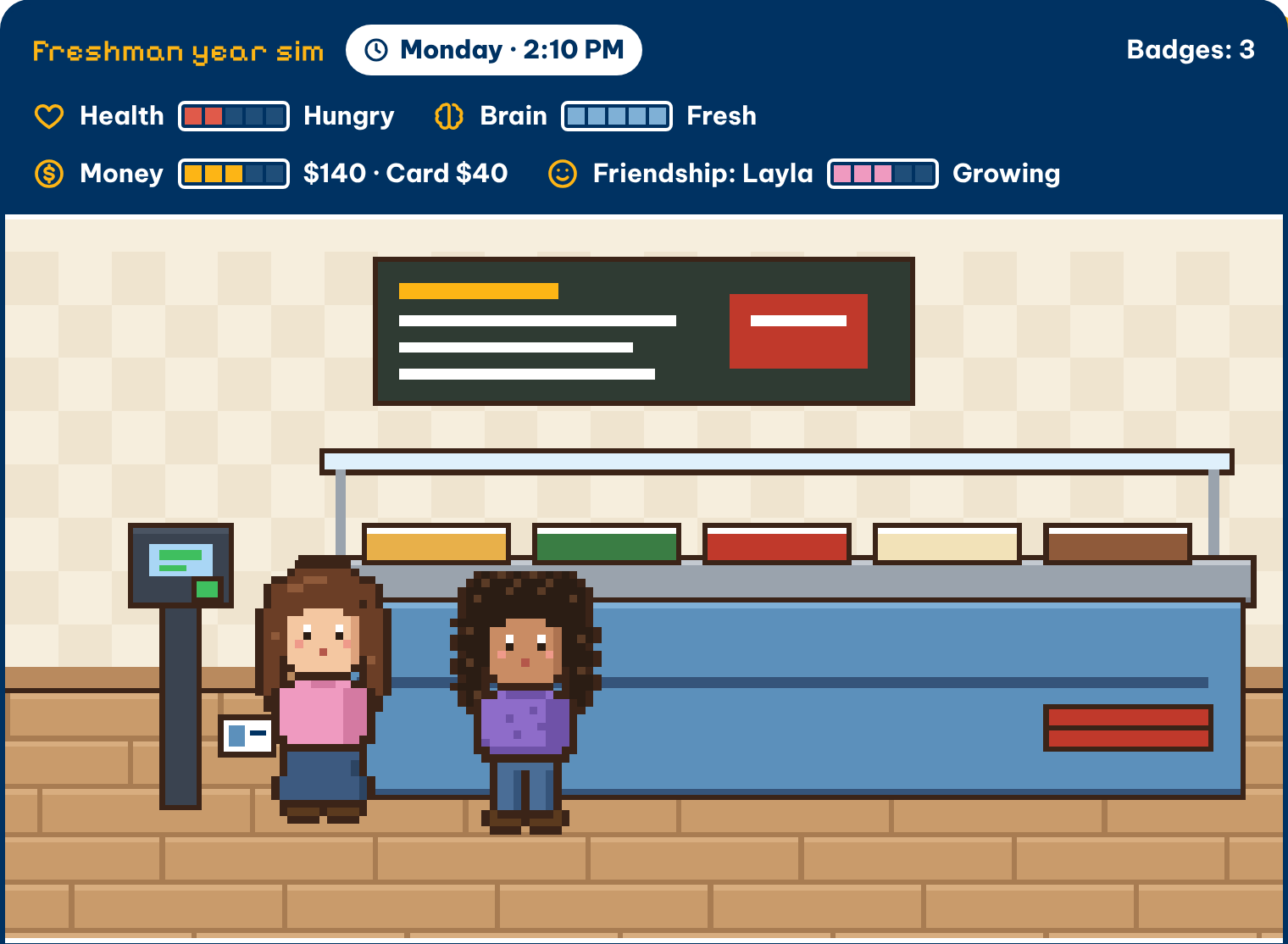
The demo’s art and game were generated with AI. If I were to actually develop this game, I would hire game designers for the gameplay and art.
Interactive · click Keep playing to live through your first term
The letter
You open your acceptance letter. Cutscenes show your high school memories, goodbyes to friends and family, and moving away.
- Big transitions
Choices and consequences
Every choice leads to a different outcome. Here are a few examples:
How it handles mistakes
When students make a mistake, they see the consequences of their choice. They can always try again the next day until they get it right.
Side quests
Not everything in the game is required. GTA 6 is full of hidden extras outside the main story, and the freshman year simulator would have optional side quests, too. They give students autonomy and choice, and the freedom to customize and explore is a big part of what makes a game fun. Each side quest improves your character’s life and unlocks a hidden badge.
Interactive · click Try this side quest to unlock each hidden badge
- Optional side questGet a part-time jobWork on campus, like at the library or in a lab for your major, close to your classes, or off campus, where a longer commute makes time harder to manage. Either way, if you’re scheduled during class, set a boundary and keep school your priority.Hidden badge
- Optional side questFind a partnerChoose whether you want a girlfriend, a boyfriend, or a partner, and build the relationship over time.Hidden badge
- Optional side questGo to the gymBuild a workout routine and take care of your health between classes.Hidden badge
- Optional side questDo community serviceVolunteer in your community and give back.Hidden badge
How I would build it
If I were to develop this game for real, here are the steps I would follow.
- Start with the learnersTalk with the high school students I volunteer with, and with current college freshmen, about what surprised them most in their first term. Their stories become the game’s moments.
- Prototype 1 moment firstBuild a small playable slice, like the class registration demo above, before designing the whole term. It’s faster to test and cheaper to change.
- Bring in game designersHire game designers and artists for the gameplay and art. My role stays on the learning design: the objectives, the choices, and the consequences.
- Design for accessibility from day 1Make sure the game works with a keyboard, never uses color alone, lets players resize text, and respects “reduce motion,” so every student can play.
- Playtest with studentsWatch students play, note where they get stuck or lose interest, and revise. Then test again.
- Pilot, measure, and adjustLaunch with a small group, review the gameplay data, and adjust before rolling it out more widely.
How I’d measure success
I’d measure success through gameplay data. Teachers could export it to see:
- How many students completed the game
- Each student’s branching timeline: the choices they made and where they got into trouble
- Whether they learned from their mistakes and made a better choice the next time
- Their success rate on each task, and which badges they earned
I’d also want to know how students felt about playing it, and whether they found it genuinely fun.
Where teachers and parents fit
The game is designed for students to play on their own, so teachers and parents don’t appear in it. Educators could review the gameplay data to see how students are doing.
The takeaway
Learning can be fun, and people often forget that. For young people especially, learning can feel like material they don’t care about or don’t see the point of.
But when we connect learning to real-life skills, it clicks. The move from high school to college is when students begin to become adult learners, so it’s important that they understand what comes next. Whenever it fits, make learning as whimsical and fun as possible, especially for people going through a big transition.